
If you're a Toronto business owner planning a new website in 2026, you're navigating a dramatically different landscape than even a few years ago. Google's ranking algorithms are more sophisticated, mobile performance expectations are higher, and the competition for Toronto-specific searches has intensified. This guide breaks down exactly what to expect from a top website design agency in Toronto — from the first discovery call to launch and beyond.
Phase 1: Discovery and Strategy (Week 1–2)
A serious Toronto website design agency doesn't start with Figma mockups. They start by understanding your business. The discovery phase of a professional Toronto web design project typically includes:
- Business goal mapping: What do you want your website to actually accomplish? More phone calls? More form submissions? Direct online sales? The answer shapes every design decision.
- Competitor analysis: Which Toronto competitors are ranking for your key searches? What are they doing well? Where are the content gaps you can exploit?
- Keyword research: Not generic keyword research — Toronto-specific research using real Google Search Console data and local search volume. Which terms do your actual potential customers in Toronto actually type?
- Technical audit (for redesigns): If you have an existing site, a proper audit identifies what's working, what's broken, which URLs have existing Google equity, and how to migrate without losing rankings.
If an agency skips this phase and jumps straight to "what colours do you like?", that's a significant red flag.
Phase 2: Design and Development (Weeks 2–6)
This is where your Toronto website takes shape. What separates a high-quality build from a mediocre one at this stage:
- Mobile-first design: In 2026, over 70% of Toronto web searches happen on smartphones. Every page should be designed for mobile screen first, then adapted for desktop — not the reverse.
- Core Web Vitals compliance: Google measures Largest Contentful Paint (LCP), Cumulative Layout Shift (CLS), and Interaction to Next Paint (INP). A proper Toronto web design agency targets LCP under 2.5 seconds, CLS under 0.1, and builds every page with these metrics as primary constraints.
- Semantic HTML and heading structure: Your H1 should contain your primary keyword exactly once. H2/H3 subheadings should use related and LSI keywords. This isn't optional — it's foundational to ranking on Google.
- Schema markup: Every service page should have Service schema. Location pages need LocalBusiness schema with correct geo-coordinates. Blog posts should have Article schema. This tells Google exactly what your page is about.
What Good SEO Integration Looks Like in 2026
The days of "we'll do SEO later" are over. In 2026, search engine optimization needs to be baked into your Toronto website from day one — not added on as an afterthought. Here's what proper SEO integration looks like during the build:
- Every page has a unique meta title (under 60 characters) with the target keyword in the first position
- Every page has a unique meta description (under 155 characters) with a clear benefit statement and call to action
- Images have descriptive alt text that naturally includes the page keyword
- Internal linking structure is intentional — every page links to 3–5 related pages using keyword-rich anchor text
- Canonical tags prevent duplicate content issues
- XML sitemap is auto-generated and submitted to Google Search Console
- Google Analytics 4 and Search Console are connected and verified before launch
If your Toronto website design proposal doesn't explicitly mention all of these, they're likely not included.
Phase 3: Content Creation (Weeks 3–5, concurrent with design)
Content is where Toronto websites win or lose on Google. The search algorithm doesn't rank designs — it ranks words. A professional Toronto agency will either write your content for you or provide detailed briefs that ensure every page meets minimum quality thresholds:
- Service pages: minimum 600 words of genuine, specific content about what you offer in Toronto, who it's for, and why you're the best choice
- Location pages: unique content for each city you serve — not just swapping a city name into a template
- FAQ sections: at minimum 5 FAQs per service page, targeting "People Also Ask" queries from Google
- Blog posts: consistent publishing schedule (ideally 2+ per week) targeting Toronto-specific keyword gaps
Thin content is one of the most common reasons Toronto websites fail to rank despite having beautiful designs. More words of genuine value = more indexable content = more search traffic.
Timeline Expectations for a Toronto Website Project
For a typical 10–15 page custom website for a Toronto business, here's a realistic timeline:
- Week 1–2: Discovery, strategy, and wireframing
- Week 2–4: Design mockups, client review, revisions
- Week 4–6: Development, content integration, SEO setup
- Week 6–7: QA testing, mobile audit, page speed testing, pre-launch checklist
- Week 7–8: Launch, Google Search Console submission, GA4 verification
Beware of agencies promising "your site in 72 hours." Fast is not the same as good — and a rushed build almost always has speed, SEO, or mobile issues that cost you rankings for months afterward.
Red Flags When Hiring a Toronto Website Design Agency
After reviewing dozens of proposals and agency portfolios across Toronto, here are the most common red flags to watch for:
- No Toronto-specific examples: If they can't show you a Toronto business they've helped rank on Google, they probably can't do it for you.
- Vague pricing: "Starts at $X" without a clear scope is a setup for scope creep and surprise invoices.
- No mention of SEO: A web design agency that doesn't mention search engine optimization in their proposal isn't building to win.
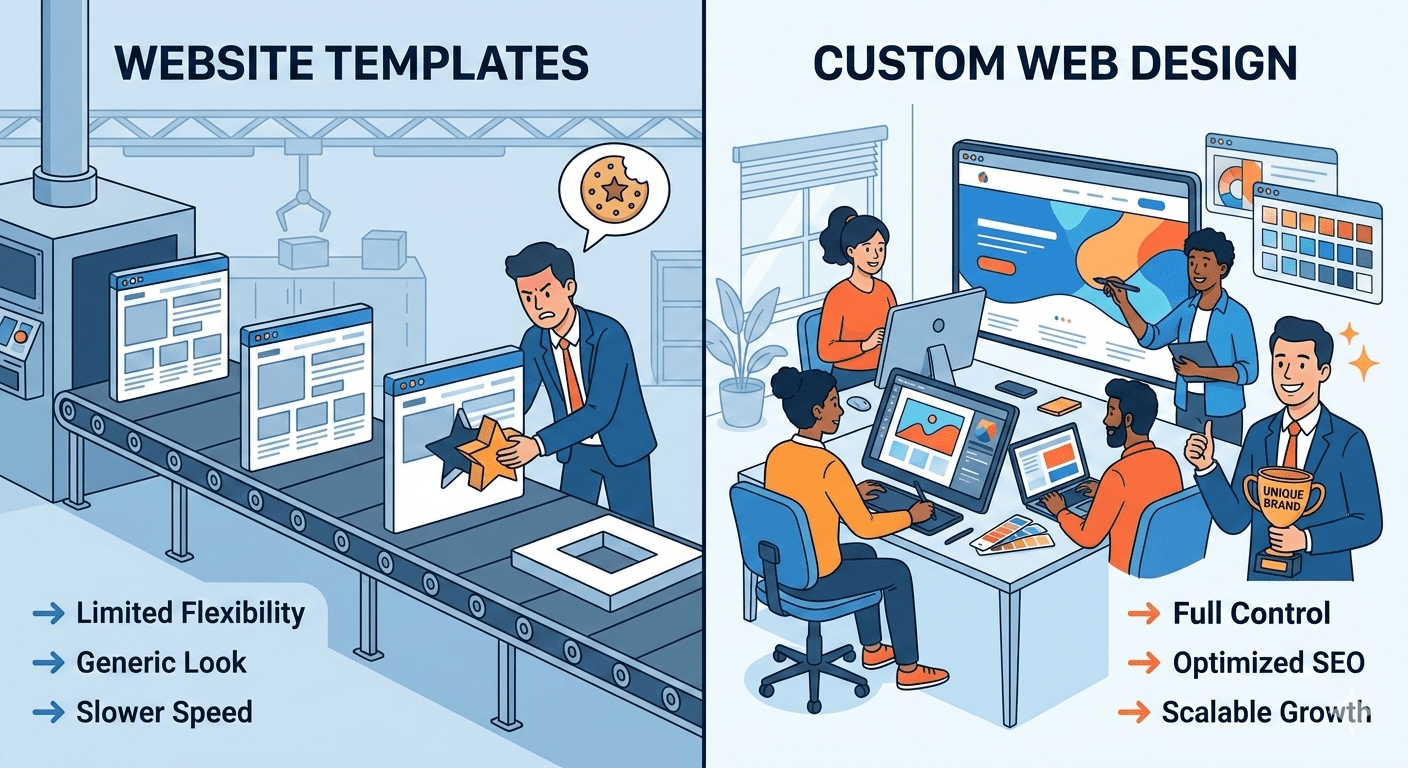
- Template upsells marketed as "custom": Ask to see the underlying code. A real custom build looks fundamentally different from a WordPress template with a new logo.
- They own your domain or hosting: You should own your domain and control your hosting. Period.
Why the Right Toronto Agency Is Worth the Investment
A well-built Toronto website typically generates 5–10x its cost in new business within the first 12 months — if it's built right. The cost of a cheap website isn't what you pay upfront; it's the leads you never get because the site doesn't rank, doesn't load fast enough, or doesn't convert the visitors it does attract.
The math is straightforward: if one new client is worth $5,000 to your Toronto business, and a quality website generates 2 extra clients per month that a cheap site wouldn't, that's $120,000 in additional annual revenue — from an investment that might have cost $4,000 more upfront.
Our web design team in Toronto has built hundreds of sites for GTA businesses. Our clients in Toronto, Mississauga, Brampton, and across the GTA consistently see ranking improvements within 60–90 days of launch. We also offer ongoing SEO packages to accelerate and maintain those rankings over time.
Get a Custom Website Design Quote for Your Toronto Business
Canadian Web Designs builds conversion-focused websites for Toronto businesses that rank on Google and generate consistent leads. 180+ five-star reviews. No contracts on SEO plans. Free consultation — no commitment required.
Book a Free Toronto Web Design Consultation →


