
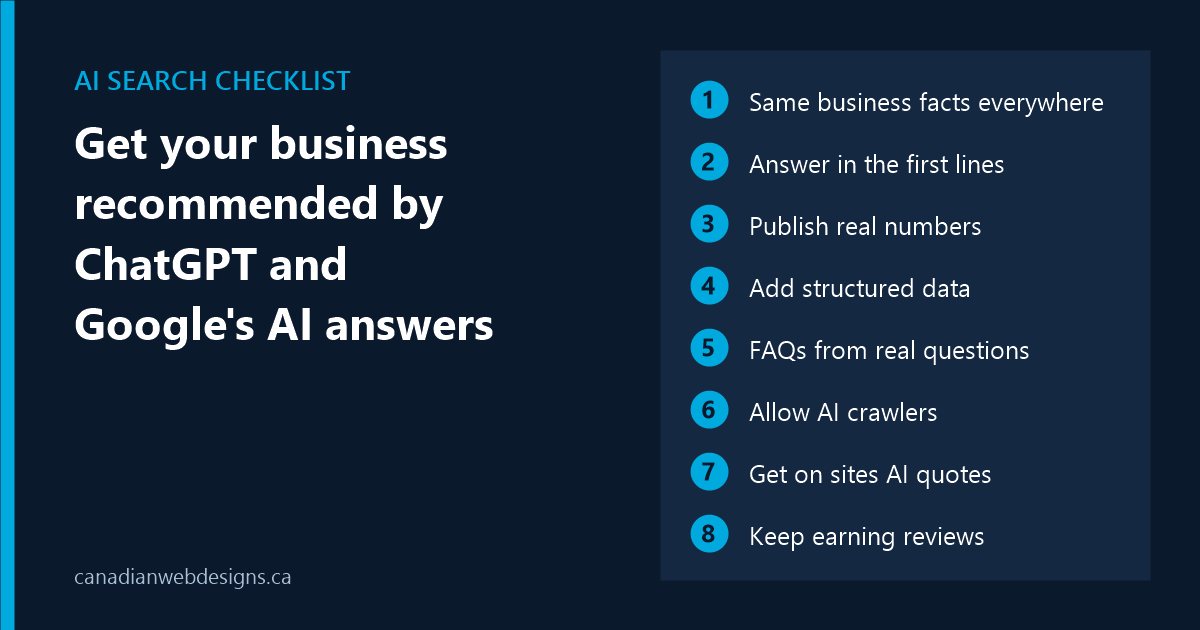
AI engines recommend businesses they can clearly identify and that other trusted sites already describe. Make your name, address and services match everywhere, publish pages that answer real questions in their first lines, and get listed on the directories and review sites these tools already quote. That is most of what people now call generative engine optimization, or AI search optimization.
The rest of this guide is the checklist we use, with what we saw when we checked AI answers for our own industry.
How AI answers choose businesses
ChatGPT, Perplexity, Google's AI Overviews and AI Mode all do two things when someone asks "who does web design in Toronto?" or "best plumber near me":
- Search the web for pages that answer the question.
- Summarize what those pages say, naming the businesses that appear clearly and consistently.
So the question is not "how do I rank in ChatGPT". It is: when an AI tool reads the pages about my type of business, is my business on them, and is it described the same way each time?
What we found in our own industry
In October 2026 we looked at the Canadian AI answers that cite our own website, using SE Ranking's AI search data:
- Google AI Overviews named our business in 52 of the 62 answers that linked to us.
- Clutch, a review directory, appeared in 30 of those 62 answers.
- Perplexity linked to our site in 297 answers, almost all of them old how-to guides, and in the first 100 it did not name the business once.
Two lessons. First, directories and review sites carry a lot of weight in these answers. Second, being cited for a how-to guide is not the same as being recommended; the page has to say who you are and what you do.
The 8-step checklist
1. Make your business facts identical everywhere
Same name, address, phone, hours and website on your site, your Google Business Profile, Bing, Apple Maps, Facebook and every directory. AI tools cross-check sources. Conflicting hours or an old address make you look like two businesses, or an unreliable one.
2. Put the answer in the first lines of every page
Start each service page with one or two sentences that answer the obvious question: what you do, where, and roughly what it costs. Then give the detail. AI summaries quote opening sentences far more than paragraph six.
3. Publish real numbers
Prices, timelines, service areas, years in business, team size. A page that says "affordable rates" gives an AI nothing to quote. A page that says "from $299, live in 1 to 2 weeks" does.
4. Add structured data
Organization or LocalBusiness schema on every page, with sameAs links to your Google Business Profile, Facebook, LinkedIn and the directories that list you. Article schema on blog posts. Our schema guide for local businesses shows the fields that matter.
5. Write FAQ sections from real questions
Use the questions customers ask you on the phone, and the "People also ask" questions Google shows for your service. Answer each in two or three sentences.
6. Decide which AI crawlers may read your site
Your robots.txt file can allow or block crawlers such as GPTBot (OpenAI), ClaudeBot (Anthropic), PerplexityBot and Google-Extended. If you want to be recommended, allow them. Some sites also publish an llms.txt file, a plain summary of the site for AI tools. It is cheap to add and easy to keep current.
7. Get onto the sites AI tools already quote
Search your main service and city in ChatGPT, Perplexity and Google, and note which outside sites the answers link to. In our industry that was Clutch, DesignRush and Reddit threads. Claim your profiles there, keep them current and make sure they match step 1. Our list of Canadian business directories is a good starting point.
8. Keep earning reviews
Reviews on Google and on industry sites are among the clearest signals that a business is real and active. Ask every happy client, and reply to every review. Our guide on getting more Google reviews covers how to ask.
How to measure it
- Google Analytics 4: look at traffic by source and watch visits and leads from chatgpt.com, perplexity.ai, gemini.google.com and copilot.microsoft.com each month.
- Ask the engines yourself the questions a customer would, once a month, and note whether you are named.
- AI search tools such as SE Ranking report how often a domain or brand appears in AI answers. Record the numbers before you start so you can compare.
What not to do
- Do not fill pages with "best" and "number one" claims. AI tools quote facts, not adjectives.
- Do not create fake reviews or directory listings. They contradict your real facts and can get listings removed.
- Do not block AI crawlers and then expect to be recommended.
Want to know how AI tools describe your business?
This work is part of our SEO packages and our AI consultation, and it builds on the same base as our SEO services. Ask for a free check and we will show you what ChatGPT, Perplexity and Google's AI answers say about your business today.


